For decades, industrial incubation has been optimized based on well-known physical variables: temperature, relative humidity, ventilation, CO2 concentration, and egg handling, among others. However, despite birds being among the most vocal animals, their vocalizations have not been widely used as indicators of day-old chick quality. During their incubation period, chicks respond to external sound stimuli, coordinating their development, modulating their behavior, and influencing their subsequent viability. Understanding what happens “from egg to first cheep” involves learning to listen to the birds from the moment they hatch.
The Invisible Symphony Within the Hatchery
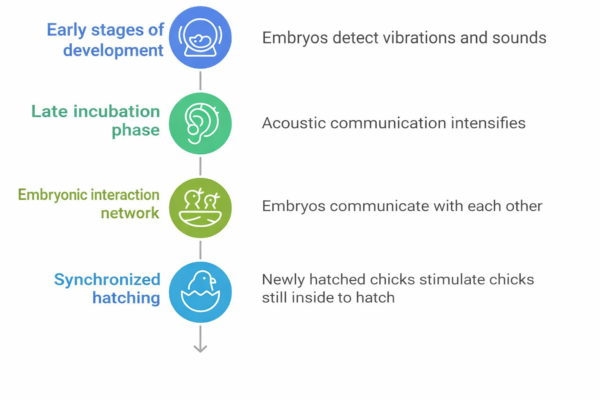
Although from the outside the hatchery appears to be a closed system, a great deal of biological activity is taking place inside. Through the eggshell, the embryos perceive vibrations and sounds from relatively early stages of development. In the final phase of incubation, when the respiratory and nervous systems are sufficiently mature, acoustic communication intensifies.
Under natural conditions, the hen incubating her eggs uses her vocalizations to stimulate the embryos, accelerating or synchronizing physiological processes that favor the hatching of chicks within a short timeframe. This mechanism has a clear adaptive value: synchronized hatching reduces the risk of predation and facilitates the simultaneous abandonment of the nest.
Detection of Internal Pipping
Some scientific studies show the early detection of internal pipping. This event marks the moment when the embryo pierces the inner membrane of the egg and begins to breathe.
Using piezoelectric microphones and highly sensitive acoustic sensors, it is possible to identify this biological milestone with an accuracy of approximately ±3 hours.
Knowing the actual, biological, not theoretical, timing of internal pecking allows for dynamic adjustments to temperature, ventilation, and CO2 profiles. If pecking occurs earlier than expected, a timely temperature reduction can prevent embryonic overheating, a common and costly problem that is often only detected when chicks already show signs of panting and stress.
The first peep
Once the chick breaks through the egg’s inner membrane, it begins to pierce, cut, and emerge from the shell. During this process, the birds begin to vocalize.
Numerous studies in experimental laboratories have demonstrated that these acoustic stimuli serve a synchronizing function. Embryos that “hear” others begin the hatching process adjust their own developmental rhythm, bringing their own birth time closer.
From a production perspective, this synchronization is critical. A wide hatching window creates significant inequalities: the first chicks to hatch remain in the hatchers for additional hours, increasing the risk of dehydration, while the last to hatch may hatch incompletely.
Currently, to obtain a true and accurate view of the hatching window, the most common method used in hatcheries is the visual counting of a limited number of randomly selected trays within the hatchery.
This procedure, although common, has several limitations:
- It depends on staff availability,
- It introduces an unavoidable degree of subjectivity, and
- It only provides a rough estimate of the total number of chicks hatched.
Furthermore, this approach does not allow for the precise identification of the moment the first hatching begins, as checks are performed sporadically rather than continuously.
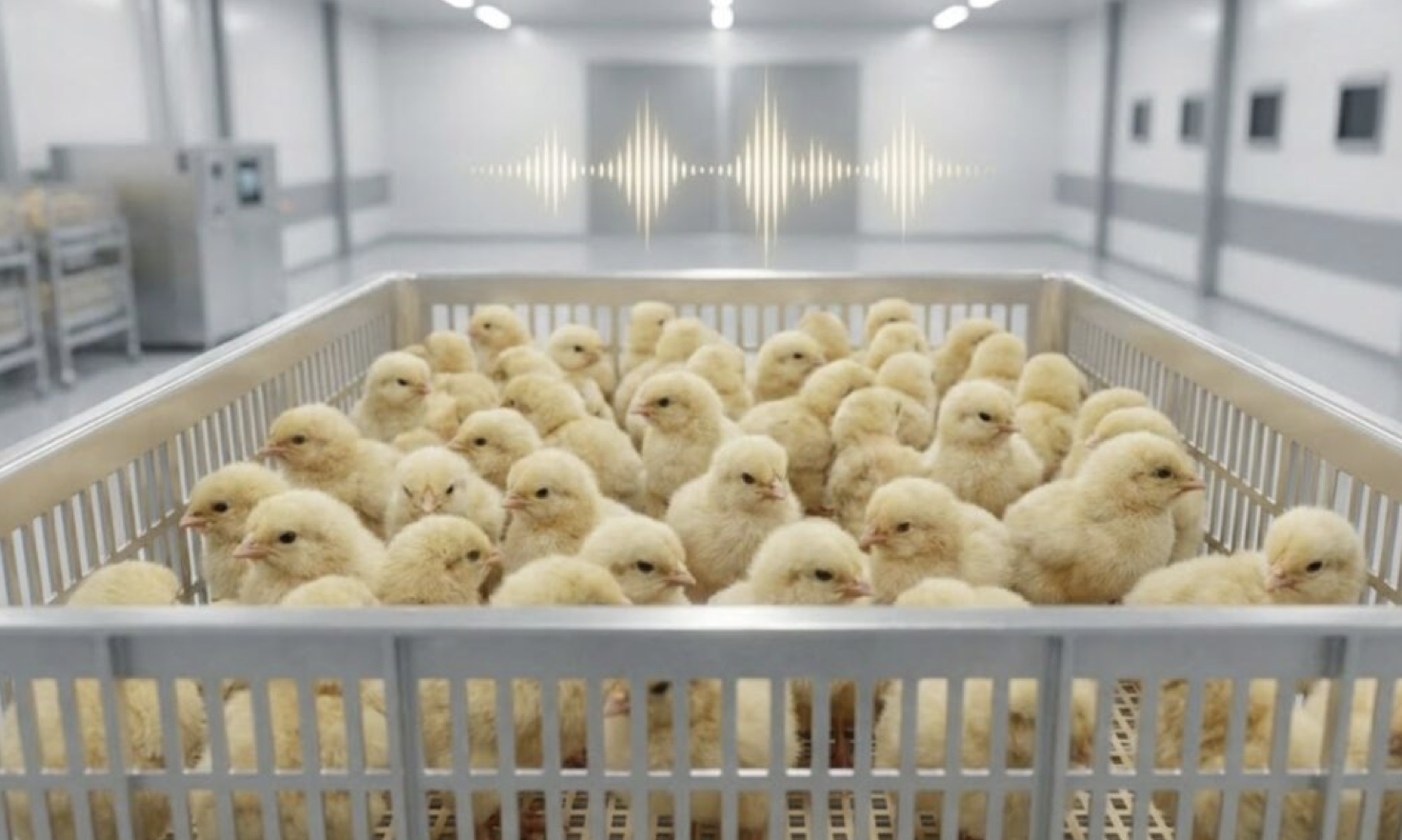
Automated acoustic detection of vocalizations within the hatchery offers an innovative and much more accurate alternative. Each chick, upon hatching, begins to emit characteristic sounds, and the analysis of these acoustic patterns allows for the continuous recording—without human intervention—of the exact moment the first hatching occurs. This type of monitoring provides a detailed temporal curve of vocal activity that reflects, in real time, the progress of hatching and the complete dynamics of the hatching window.
Achieving a narrower hatching window with less temporal variation directly translates into greater flock uniformity and higher-quality chicks. Synchronized hatching significantly reduces weight differences at birth, decreases dehydration in early-hatched chicks, and prevents the emergence of weak birds, thus improving subsequent farm performance.
The Importance of Monitoring Chick Shipping
To deliver chicks to the customer, the birds are dried, sexed, vaccinated, and sorted to remove unsuitable chicks. Finally, they are counted and packed into transport boxes. This industrial process generates stress that affects the birds. In the shipping room, the birds stabilize their body temperature and recover after hatching while the transport logistics team organizes their collection. Monitoring and controlling the conditions in the shipping room is key to ensuring the animals are in optimal condition before transport and preventing stress.
Under optimal conditions, chicks emit a rhythmic chirping associated with normal activity. However, excessive density and the resulting increase in temperature lead to panting, accompanied by a marked reduction in vocalizations, while cold areas caused by poor air distribution produce high-pitched distress calls.
Acoustically monitoring the birds in the sexing and shipping rooms allows for the detection of vocalization patterns to optimize management and maximize flock welfare.
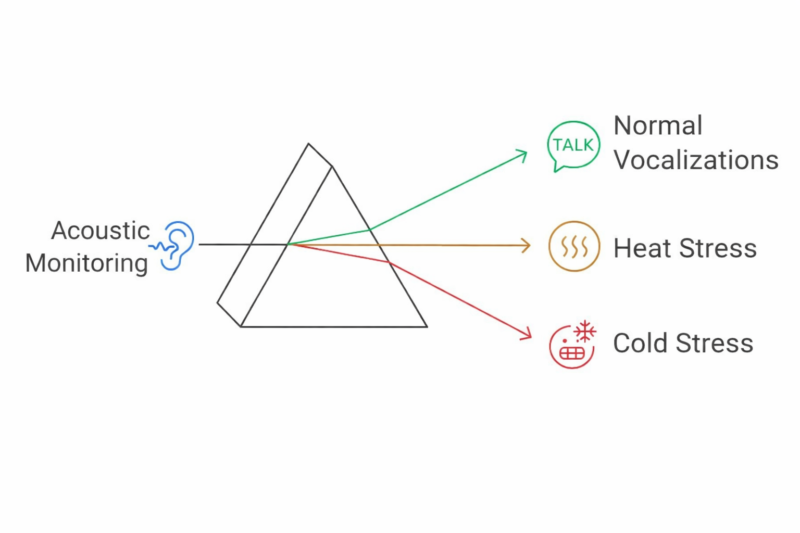
Bioacoustics allows us to listen nonstop to everything the chicks “tell” us, from the moment they hatch until they’re loaded onto the truck for the farms.
From embryonic clicks to the first “peeps,” vocalizations offer real-time information about the physiological state of the embryo and the newly hatched chick. Learning to listen in the hatchery and the shipping room not only improves hatching timing and chick quality but also opens the door to more precise, adaptable incubation aligned with the bird’s natural biology.
In a context of high production demands and a growing focus on animal welfare, the future of incubation cannot depend solely on better temperature or humidity sensors, but also on measuring and interpreting the indicators generated by the birds themselves, such as vocalizations. Paying attention to what embryos and chicks communicate is a fundamental step toward more efficient, sensitive, and truly animal-centered incubation systems.